
Office Dilapidations
London
Professional office dilapidation and reinstatement services across London, helping tenants and landlords manage lease-end works efficiently, control costs and return commercial premises to the required condition.

Lease-end reinstatement

Minimal disruption

End-to-end delivery
COMPLIMENTARY DILAPIDATIONS ASSESSMENT
Understand Your Dilapidation Costs For Free
Meet with our dilapidations specialists and receive clear, practical advice on your lease-end requirements with no obligation to proceed.

Free on-site assessment
Review of landlord’s schedule
Itemised reinstatement quote
Estimated completion timeline
Advice to avoid unnecessary work
No obligation · Available across London
Office Dilapidations
Whether you are relocating, downsizing or approaching the end of a commercial lease, your landlord may require the office to be returned to a specific condition.
Turnea provides office dilapidation and reinstatement services across London, helping businesses manage the practical works required before handover.
We can work from a landlord’s schedule of dilapidations, surveyor’s report or agreed scope of works and coordinate the different trades required to complete the reinstatement.
From removing partitions and tenant installations to repairs, decoration, flooring and electrical alterations, our team can manage the process from assessment through to completion.

A Balancing Act
Dilapidation projects often involve three competing priorities: meeting the landlord’s requirements, controlling costs and completing the works before the lease ends.Our role is to help bring those priorities together.
We review the scope carefully, identify the practical works required and create a clear programme for completion.
Typical office dilapidation works can include:
- Removal of partitions
- Removal of tenant fixtures and fittings
- Flooring repairs or replacement
- Ceiling repairs
- Painting and decoration
- Lighting alterations
- Electrical reinstatement
- Data cabling removal
- Kitchen or tea point removal
- Joinery removal
- Making good walls and finishes
- General repairs
- Final cleaning
A Careful Assessment
Before any works begin, it is important to understand exactly what needs to be reinstated.
Turnea can assess the existing office, review the condition of the space and help define the practical scope of works.
Where a formal schedule of dilapidations has already been issued, we can work from that document and coordinate the required remedial works.
Where the scope is still being agreed, we can help identify likely reinstatement requirements and provide practical input before the project starts.
This early assessment can help avoid unnecessary work, reduce last-minute pressure and give you a clearer understanding of likely costs and timescales.
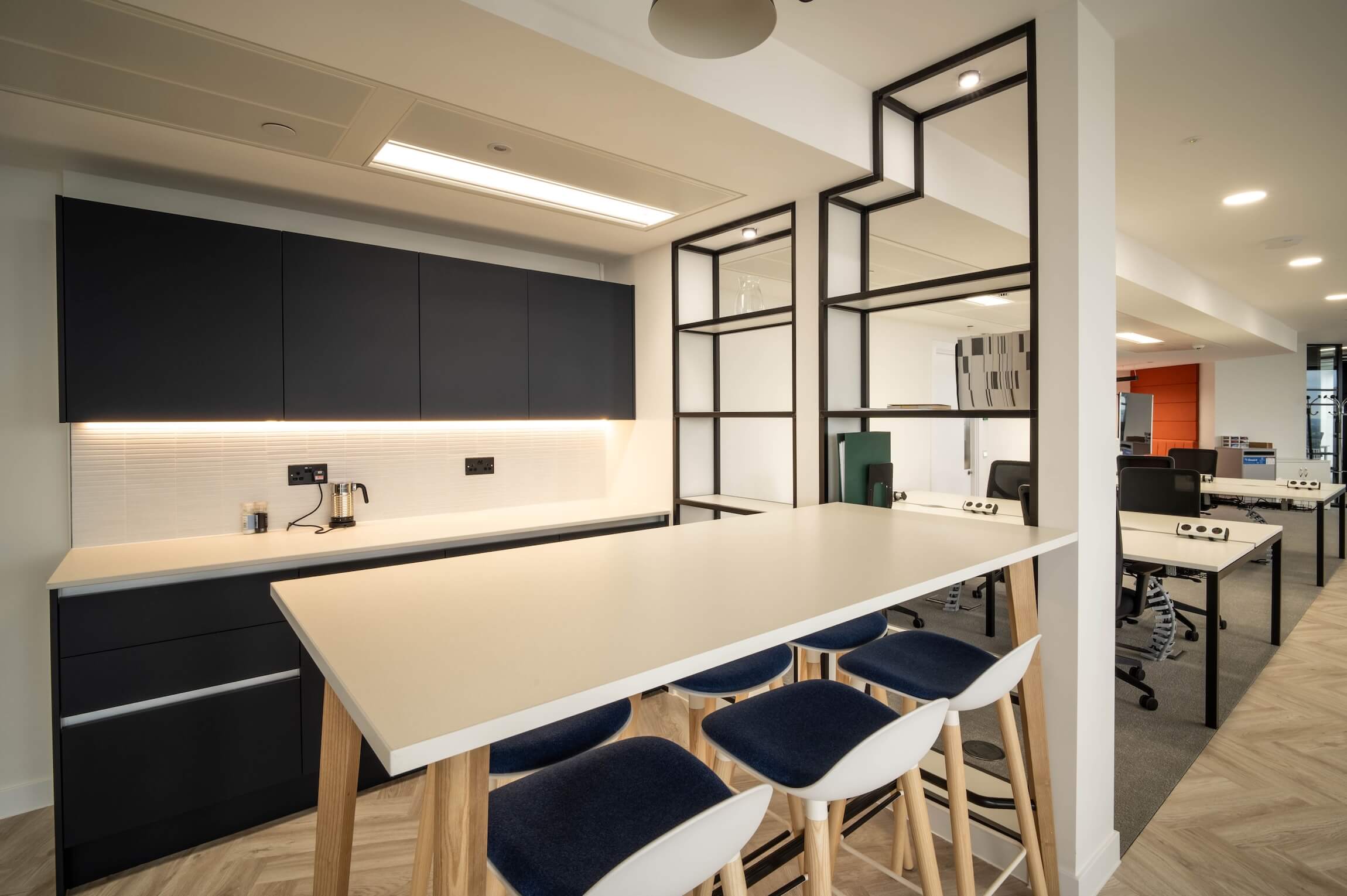
Moving In and Out
Office dilapidations are often only one part of a wider relocation.
If you are leaving one office and moving into another, Turnea can help coordinate both sides of the process.
We can manage the reinstatement of your existing premises while also supporting the office fit out, refurbishment or space planning of your new workplace.
This can include:
- Dilapidation and reinstatement works
- Removal of existing office installations
- Coordination with landlords and surveyors
- Office fit out
- Office refurbishment
- Space planning
- Furniture installation
- Project management
Using one team for both locations can simplify communication, reduce duplication and help make the move more coordinated.
Office dilapidations projects


Our Fit-Out Process
Initial Consultation
We discuss your lease-end date, property, landlord requirements and the current condition of the office.
Site Assessment
Our team reviews the workplace and identifies the works likely to be required.
Scope of Works
We define the reinstatement requirements and review any existing schedule of dilapidations.
Proposal & Programme
You receive a clear proposal outlining the recommended works, likely costs and expected timescale.
Dilapidation Works
Turnea coordinates the contractors and practical reinstatement works.
Completion & Handover
The completed works are checked so the property can be handed back in the agreed condition.
Questions & answers
What is office dilapidation?
Office dilapidations are works required to return a commercial property to the condition set out in the lease at the end of a tenancy.
This can include removing alterations, repairing damage, redecorating and reinstating parts of the office.
What exactly is a dilapidation survey?
A dilapidation survey reviews the condition of the property and identifies areas that may require repair or reinstatement.
A landlord or surveyor may use this information to produce a schedule of dilapidations setting out the works they believe are required.
When should I start planning for dilapidations?
It is best to start planning well before the end of the lease.
Early preparation gives you more time to understand the likely works, obtain costs, coordinate contractors and avoid unnecessary last-minute pressure.
How can you help us minimise dilapidation costs at the end of our lease?
We help define the practical scope of works, coordinate the project efficiently and identify where unnecessary work may be avoided.
Clear planning can also reduce the risk of rushed decisions and expensive last-minute work.
Can you handle both our new office fit-out and dilapidation works simultaneously?
Yes.
Turnea can coordinate the reinstatement of your existing office while also managing the fit out or refurbishment of your new workplace.
This can make the overall relocation easier to manage and gives you one team across both projects.
Do you work with surveyors and landlords during dilapidation works?
Yes.
Where required, we can work alongside surveyors, landlords, building managers and other parties involved in the lease-end handover process.
What's your approach to sustainability in dilapidation works?
Where practical, we consider whether furniture, materials and fittings can be reused, recycled or responsibly disposed of rather than automatically being treated as waste.
How long do office dilapidation works take?
Timescales depend on the size of the office, the scope of reinstatement works and the condition of the property.
Smaller projects may take a few weeks, while larger or more complex dilapidation projects may require a longer programme.Can you work to a fixed lease-end date?
Yes, where practical.
The earlier we are involved, the more opportunity there is to plan the works around the required handover date.What happens if we have not yet received a schedule of dilapidations?
We can still review the property and discuss the likely areas that may require reinstatement.
Where formal lease interpretation is required, this should be handled by the appropriate surveyor or legal adviser, but we can support the practical delivery side of the project.